Trust & Security
This page is written for the person who has to clear Hush through a security review. Every claim on it is something you can check yourself, and the limits are stated as plainly as the strengths. Paste this URL into your vendor-review form.
The short version
Hush is a meeting transcription and analysis app that does its work on your Mac. The question most security reviews exist to answer, “how does this vendor protect our data on their servers?”, does not arise, because there are no servers holding your data. These five facts carry most reviews, and each one is checkable.
Local-only processing
Recording, transcription, speaker labeling, analysis, and search all run on the Mac in front of you. Nothing is uploaded.
Check it: the data-flow overview below, or run Hush with the network off.
Zero telemetry
No analytics, no crash reporting, no usage tracking, no account. The app has nothing to phone home with.
Check it: watch the app's connections with Little Snitch or Activity Monitor.
Signed and notarized by Apple
Every release is Developer ID signed with the Hardened Runtime, notarized by Apple, and stapled.
Check it: spctl -a -t open --context context:primary-signature Hush.dmg, or codesign --verify --deep --strict /Applications/Hush.app.
Software bill of materials
A CycloneDX SBOM and third-party notices ship inside every release, and we send the current file to reviewers on request.
Check it: open Hush.app/Contents/Resources/Documentation in your beta build, or ask us for the file.
Vulnerability disclosure policy
A named reporting channel, an acknowledgement window, and coordinated disclosure.
Check it: the policy is on this page.
Data flow, on one page
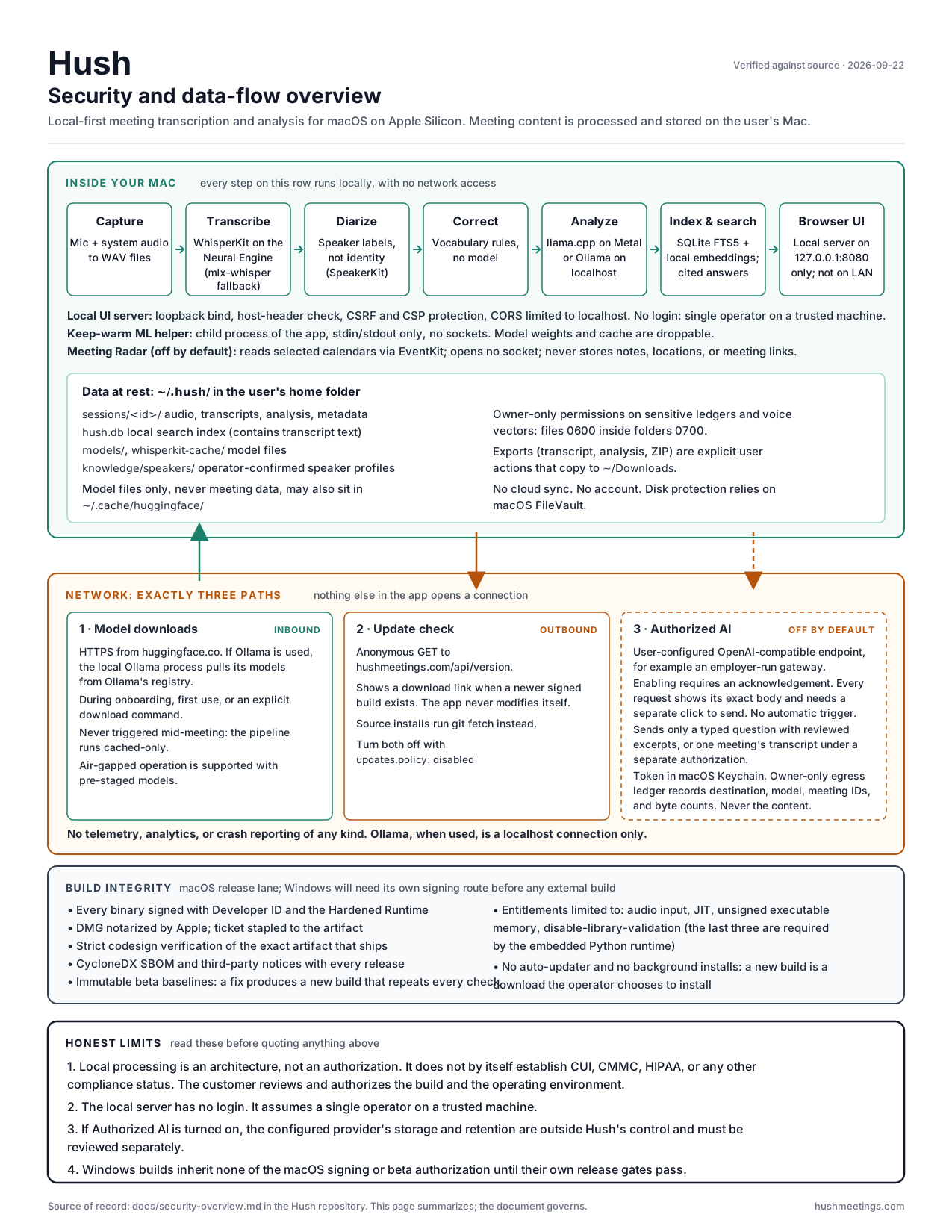
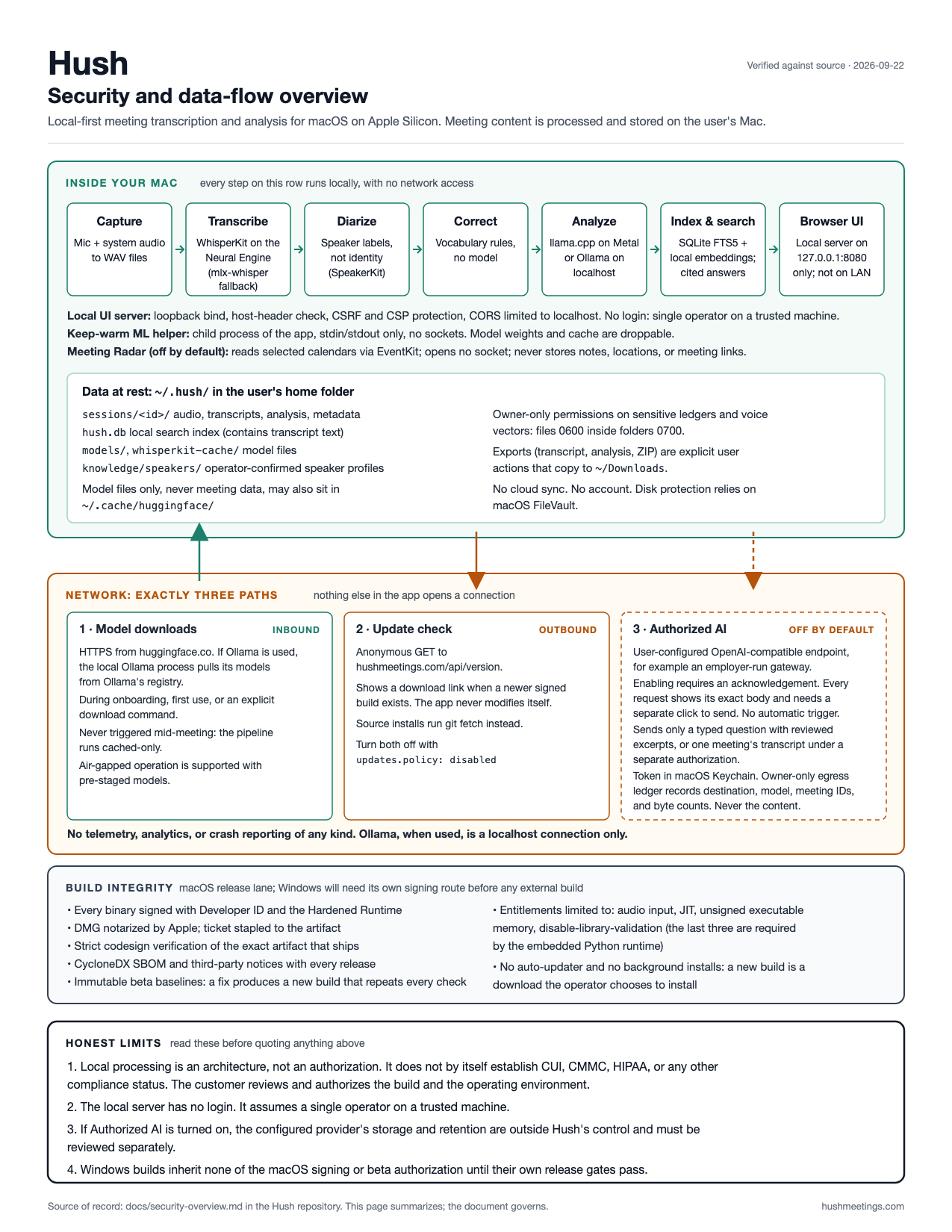
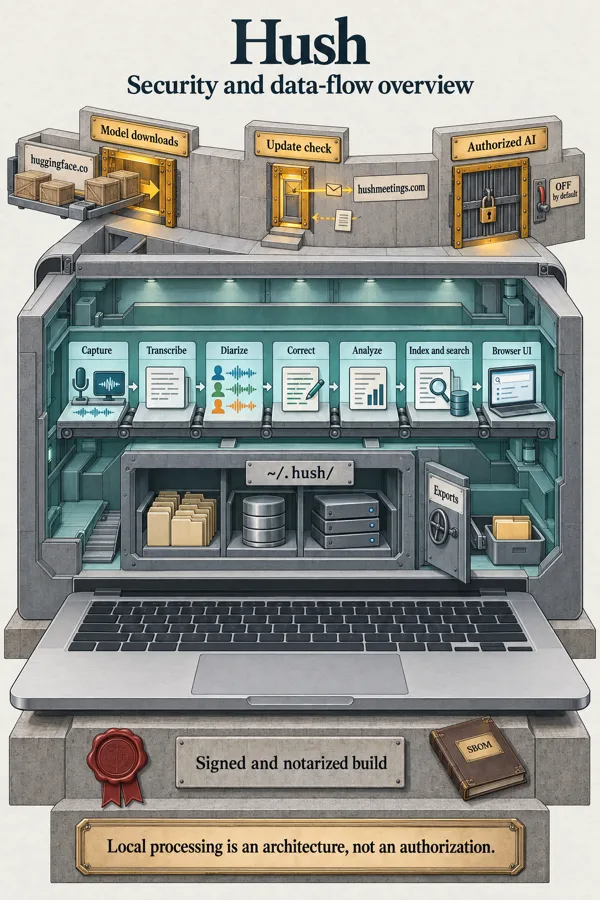
One page, drawn from the source. Inside the green boundary is everything that runs on your Mac. Exactly three paths cross the network, and only one of them can ever carry meeting content, and only when you turn it on and confirm each request.
What crosses the network
Exactly three things. Nothing else in the app opens a connection.
- Model downloads, inbound. Speech and language models are fetched over HTTPS from huggingface.co during onboarding, first use, or an explicit download command. If you choose Ollama for analysis, Hush asks the local Ollama process to pull its models, and Ollama fetches them from its own registry. A download is never triggered during a meeting; the pipeline runs only from models already on disk. Air-gapped machines can be set up with pre-staged models.
- Update check, outbound. Release builds make an anonymous request to hushmeetings.com/api/version and show a download link if a newer signed build exists. The app never modifies itself and never installs anything in the background. Setting
updates.policy: disabledturns the check off. - Authorized AI, outbound, off by default.You may configure an OpenAI-compatible endpoint, such as an employer-run gateway, for the final step of answering a question. Enabling it requires an acknowledgement. Every request shows its exact outbound body and needs a separate click to send. Only a question you typed with the excerpts you reviewed, or under a separate authorization one meeting's transcript, is ever sent. No recording, automatic analysis, suggestion, or error can trigger it. The credential lives in macOS Keychain, and an owner-only ledger records destination, model, meeting IDs, and byte counts, never the content.
The local model server, if you use Ollama, is a localhost connection only. There is no telemetry, analytics, or crash reporting of any kind.
Where your data lives
Everything Hush produces lives in ~/.hush/in your home folder: sessions with audio, transcripts, analysis, and metadata; a local search index; downloaded model files; and any speaker profiles you have confirmed. Sensitive ledgers and learned voice profiles are owner-only files inside owner-only folders. Exports are explicit actions that copy a transcript, analysis, or archive to your Downloads folder. There is no cloud sync and no account. Protection of the disk itself is your Mac's job, through FileVault and your login.
The browser interface is served by a local process bound to 127.0.0.1 only. It is not reachable from your network, checks the host header against DNS rebinding, and carries CSRF and content security policy protections.
Build integrity
- Every binary is signed with an Apple Developer ID and the Hardened Runtime.
- The installer image is notarized by Apple and the ticket is stapled to it.
- The exact artifact that ships is strictly verified before it is published.
- Entitlements are limited to audio input, JIT, unsigned executable memory, and disable-library-validation. The last three are required by the embedded Python runtime.
- A CycloneDX software bill of materials and third-party notices ship inside every release. We send the current file to reviewers on request rather than posting it publicly, so we know who holds each copy.
- Beta baselines are immutable. A fix produces a new build that repeats every release check; nothing is patched in place.
Compliance posture
Most vendor questionnaires ask about the same frameworks. Here are the honest answers, in the order they usually come up.
SOC 2
Not applicable today. A SOC 2 report attests to how a vendor protects customer data held on the vendor's systems. Hush holds none: meeting audio, transcripts, and search indexes stay on your Mac and never reach us. We will revisit a scoped audit of our release pipeline and website if a customer's review requires it.
HIPAA
Hush is not a business associate. A vendor becomes a business associate by creating, receiving, storing, or transmitting protected health information on a covered entity's behalf. Hush does none of those things, so a Business Associate Agreement with us has nothing to cover. Whether your use of Hush on a given machine meets your organization's obligations is your determination; the honest limits below are the place to start. If you point the optional Authorized AI path at a cloud provider, that provider is the one who needs an agreement with you.
GDPR
Hush is not a processor for your meeting content. Your organization is the controller and your own Mac does the processing, so there is no data-processing agreement for us to sign for meeting data. Hush is built the way GDPR asks: no data leaves the device, sessions are deletable, and learned voice profiles can be forgotten with one control. For the small amount of personal data this website collects when you request beta access, see the privacy policy.
CUI, CMMC, RMF, and classified use
Not established by architecture. Local processing is an architecture, not an authorization. It does not make Hush approved for controlled unclassified information, classified systems, or any CMMC level. Software below the system level is assessed inside the customer's own authorization boundary, and the customer's authorizing official accepts the risk. What we provide is assessment-ready evidence: this page, the data-flow overview, the SBOM, and signed builds.
Statement for your vendor file
If your process needs a document rather than a web page, this paragraph is written to be filed as-is. We will confirm it in writing, on request, for your specific review.
Hush is a local-first meeting transcription and analysis application for macOS. All recording, transcription, speaker labeling, analysis, and search run on the customer's own computer. The maker of Hush does not receive, store, transmit, or have access to any customer meeting audio, transcript, summary, or search data. The application sends no telemetry. Its only network activity is inbound model downloads from a public model repository, an anonymous version check that can be disabled, and an optional, off-by-default, user-configured AI endpoint that transmits only what the user reviews and confirms per request. Because the maker of Hush never handles customer data, a Business Associate Agreement under HIPAA and a data-processing agreement under GDPR have no data to cover, and a SOC 2 report would attest to systems that hold no customer data. Release builds are Developer ID signed, notarized by Apple, and shipped with a CycloneDX software bill of materials. Local processing is an architecture, not an authorization; the customer remains responsible for authorizing the build and its operating environment.
Honest limits
Read these before quoting anything above.
- Local processing is an architecture, not an authorization. It does not by itself establish CUI, CMMC, HIPAA, or any other compliance status. You review and authorize the build and the operating environment.
- The local server has no login. It assumes a single operator on a trusted machine, protected by that machine's own login and disk protection.
- If Authorized AI is turned on, the provider you configure holds whatever you choose to send it. Its storage and retention are outside Hush's control and must be reviewed separately.
- Windows builds, when they arrive, inherit none of the macOS signing or beta authorization until their own release gates pass.
Report a vulnerability
Email beta@hushmeetings.com with “Security” in the subject line. Include the Hush version, your macOS version, steps to reproduce, and what you believe the impact is. Please do not include meeting audio or transcripts; a redacted example or a synthetic recording is enough.
- You will get an acknowledgement within five business days.
- Fixes ship as a new signed build rather than a patch in place. We will tell you when a fix is available and agree a disclosure date with you. Please give us a reasonable window before publishing details.
- In scope: the Hush app and its local ML backend, the release packaging and update check, and the code-gated download flow on this site. Out of scope: your own Authorized AI endpoint or any third-party model provider, upstream projects such as Ollama and WhisperKit (report those upstream, and tell us too), and findings that require the attacker to already control the local machine or the operator's account.
- Only the current beta build and its named rollback build receive fixes. Older builds are not patched; update to the current signed build.
Downloads
- Security and data-flow overview (SVG) · PNG
- Software bill of materials (CycloneDX 1.5, JSON): sent on request to beta@hushmeetings.com. Tell us who you are and which review it is for. The record copy ships inside the app at
Hush.app/Contents/Resources/Documentation/sbom.json. - Architecture illustration (WebP)
Updating these files is a step in the release checklist, so they can lag a release by a little. If a claim on this page and the shipped build ever disagree, the build is the truth and we want to hear about it.